
Paste a spec.
Publish an MCP server.
OpenAPI or GraphQL in, hosted MCP out — with AI-written tool descriptions, per-customer authentication, request logs and quotas from minute one. No MCP code, no OAuth plumbing, no new repo.
Every REST operation or GraphQL query/mutation becomes one typed MCP tool — arguments, auth, and nullability-safe queries handled for you.
Agent-grade docs per tool: when to use it, exact argument formats, enum values, where to get IDs. Editable, regenerable.
Stable MCP URL, hosted connect page for your customers, one-click client configs, logs and usage from the first call.
Three steps, one afternoon
- 1 — Scan. Paste an OpenAPI 3.x spec (JSON/YAML or URL) or a GraphQL endpoint we introspect. A setup token is only used for scanning — never for your customers' calls.
- 2 — Pick tools. Review the generated tools, keep the ones you want to expose, mark read vs write. AI writes the agent-facing descriptions in the background.
- 3 — Publish. Get — or your own domain. Customers connect from Claude with their own account, immediately.
https://commandplusk.com/api/public/mcp/d/<your-slug>
Case: AnnounceKit's changelog API, as an MCP
AnnounceKit — a changelog & product-updates SaaS — pointed the wizard at its GraphQL API. The scan produced 84 typed tools (posts, feeds, feedback, analytics, segments…), descriptions were AI-written, and the MCP went live on a stable URL the same afternoon. This is its dashboard:
Every call is attributed to the customer who made it — not to a shared key. That's what turns "we have an MCP" into "our customers use our product from Claude, safely":
| Customer | Calls | Failures | Top tool | Last activity |
|---|---|---|---|---|
| ada@loopwork.io | 613 | 17 | post | 8:57 PM |
| felix@brightpath.app | 409 | 11 | me | 8:33 PM |
| admin@commandplusk.com | 23 | 6 | post | 4:51 PM |
What your customer does: paste one URL
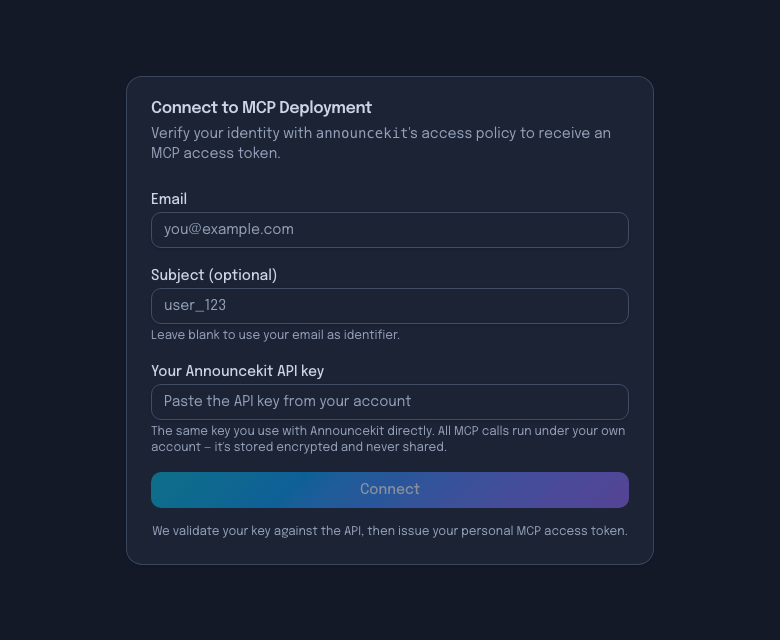
Your customer adds your MCP URL to Claude, Cursor or ChatGPT. The client discovers the auth flow automatically (OAuth 2.1 discovery + dynamic client registration) and opens your hosted connect page — no config files, no token copy-paste:
GraphQL and OpenAPI, done carefully
- Nullability-safe GraphQL. Generated selection sets stay lean and avoid non-nullable landmines that break whole queries — a real-world failure mode we hit and fixed with live traffic.
- Typed arguments. Path/query/header params, request bodies, enums and defaults carry through from your schema.
- Re-sync on change. When your API evolves, re-scan from Setup → Tools; version snapshots keep existing clients stable.
Verified with real clients — Claude, Cursor and ChatGPT
Pricing that starts at zero
Free tier: 1 MCP endpoint, 2,500 requests/month, no card. Paid: $9.99 per endpoint/month with 10,000 requests included, then $0.50 per additional 100k. Pause or archive an endpoint and it drops off your bill at the next prorated cycle.